
How a Single Russian Word Can Replace an Entire English Sentence
How Russian packs whole sentences into one word: передумал, выговорился and more. See the power of Russian compression.
BeFluent Team
12 Jan 2026 · ~6 min read

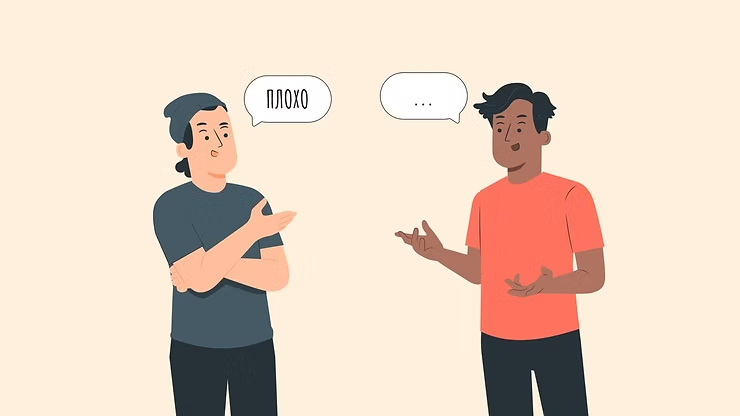
Russian is a remarkably compact language. Where English often needs several words — sometimes a full sentence — Russian can express the same idea with just one word. This isn't poetic style or shorthand. It's built into the structure of the language: prefixes, suffixes, verbal aspect, and context allow Russian words to carry multiple layers of meaning at once. As you learn Russian, you'll discover these fascinating aspects of the language. This is why some words are completely untranslatable and why understanding essential Russian keywords is so important. Understanding verb prefixes is also crucial - they're similar to what you'll learn about perfective and imperfective aspects in Russian grammar.
For English speakers, this can feel surprising. One Russian verb may contain the action, the result, the emotion, and even the attitude behind the action. Below are the clearest examples of this linguistic "compression."
1. One word = a full change of mind
передумал
English: I changed my mind.
Russian encodes the entire meaning — the initial decision, the shift, and the completion of that shift — in a single word.
2. One word = an emotional process + the relief afterward
выговорился
English: I finally said everything I needed to say to feel better.
The Russian verb captures:
- the emotional buildup
- the process of speaking
- and the feeling of relief
All in one word.
3. One word = "I arrived later than I should have"
опоздал
English: I arrived later than I was supposed to.
Russian includes the idea of being late without naming the event. The context fills in the details.
4. One word = "I figured it out on my own"
догадался
English: I figured it out myself after thinking about it.
This verb encodes independent realization and a successful conclusion — ideas English expresses with a full phrase.
5. One word = "I ate more than I should have"
переел
English: I ate too much.
But the Russian prefix пере- adds a nuance: you didn't just eat a lot — you overdid it.
6. One word = the action + the direction + the completion
подошёл
English: I approached / I came closer / I walked up to you.
Russian packages the movement, direction, and completion into a single verb.
7. One word = an action plus the emotion behind it
хмуриться
English: to frown in a way that shows you're displeased or deep in thought.
The Russian verb implies both the expression and the mood.
8. One word = "I went through the details and understood everything"
разобрался
English: I figured it out / I sorted it out / I understood how it works.
Russian compresses the process and the successful result into one form.
9. One word = congratulating someone on a specific occasion
поздравил
English often requires specifying the context: I congratulated him/her on the holiday / the promotion / the achievement.
Russian doesn't. One word covers the act and the occasion implicitly.
10. One word = a complex emotional state
стыдно
English typically explains it: I feel embarrassed / ashamed / uncomfortable because of what I did.
Russian expresses the state in one compact form.
Why Russian can do this
Russian words often function as meaning containers. They can carry:
- the action
- the direction
- the emotional tone
- the completion or incompletion of the action
- the speaker's attitude
- the surrounding context
English separates these elements into separate words. Russian fuses them.
The result: one Russian word frequently equals an English sentence — sometimes two.
Want to master this powerful side of Russian? Learn with BeFluent! Click the banner below:
Structured lessons, daily practice and a built-in dictionary — free to start.
Start learning free


Practise this in a real conversation
Lessons turn what you just read into conversations you can actually hold. Try free for 3 days
3 days free · cancel anytime