
Hello, How Are You & Goodbye in Russian: What Natives Actually Say
How to say hello in Russian — formal Здравствуйте, casual Привет and what natives really say. Plus "how are you", real answers and goodbyes.
BeFluent Team
14 Oct 2026 · ~7 min read

Most textbooks teach you one way to say hello, one way to ask "how are you" and one way to answer. Then you meet a real Russian, and they often say things a little differently. This guide covers the most common greetings you'll actually hear — formal and casual, in person, on the phone and in texts — plus the mistakes that instantly make you sound like a textbook.
The short answer
If you only remember five phrases, make it these:
| Russian | Pronunciation | Meaning | When |
|---|---|---|---|
| Здравствуйте | ZDRAST-vooy-tye | Hello | Strangers, work, anyone older — the safe default |
| Привет | pree-VYET | Hi | Friends, people your age |
| Как дела? | kak dee-LA | How are you? | People you know |
| Нормально | nar-MAL-na | Fine / OK | The most common real answer |
| Пока / До свидания | pa-KA / da svee-DA-nee-ya | Bye / Goodbye | Casual / formal |
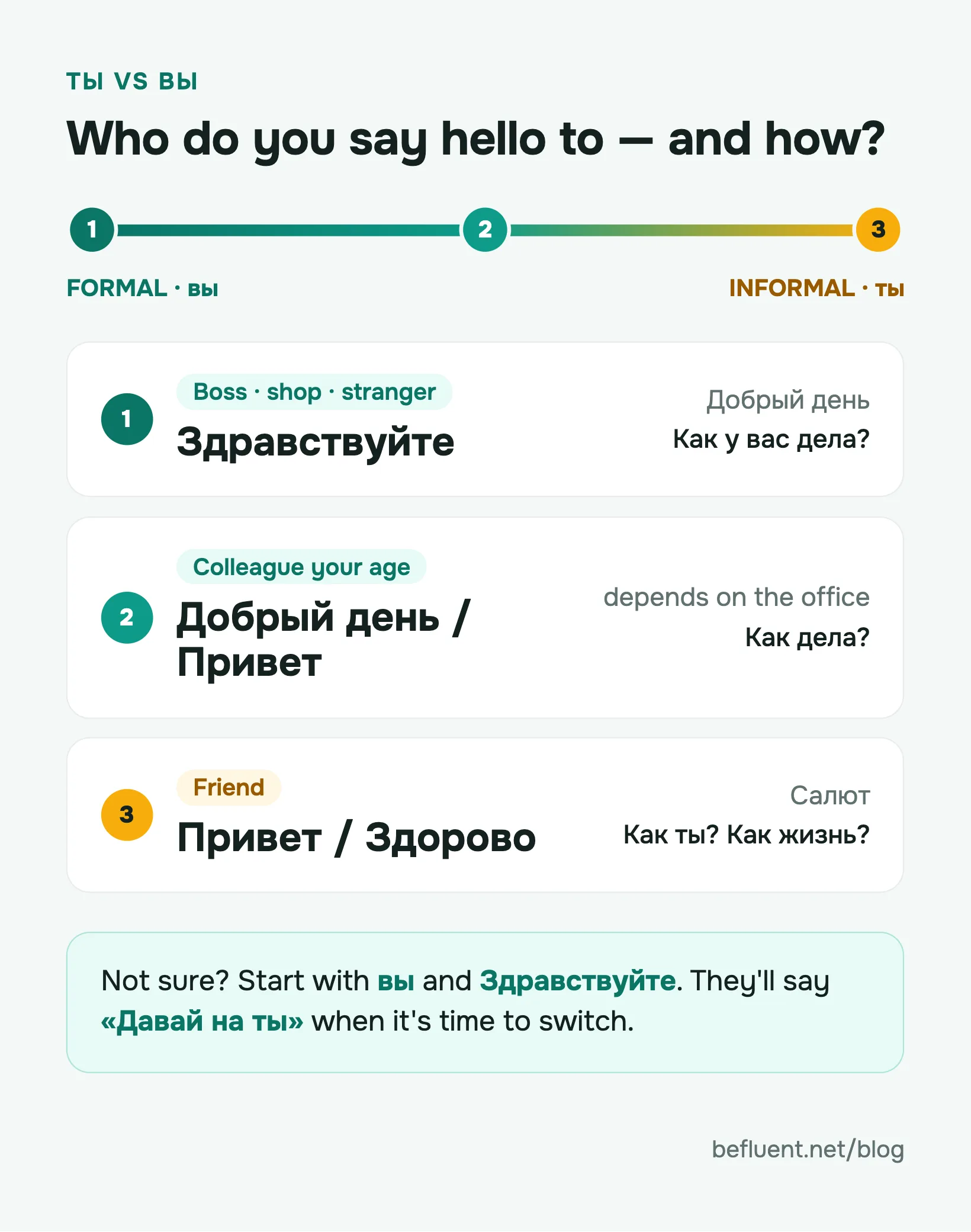
The rule behind all of it: use вы-forms with strangers, at work and with older people, and ты-forms with friends and family.
Formal or informal? Ты vs вы in 30 seconds
Russian has two words for "you": ты (informal, one person) and вы (formal, or more than one person). Your greeting has to match.
| Talking to… | Say hello with | Ask how they are with |
|---|---|---|
| A shop assistant, a waiter, a stranger | Здравствуйте / Добрый день | — (you usually don't ask) |
| Your boss, a teacher, an older neighbour | Здравствуйте | Как у вас дела? / Как вы? |
| A colleague your age | Привет / Добрый день | Как дела? |
| A friend | Привет / Здорово / Салют | Как дела? / Как ты? / Как жизнь? |
Not sure? Start with вы and Здравствуйте. Russians will tell you when it's time to switch to ты — you'll often hear «Давай на ты» ("Let's use ты").
How to say hello in Russian
Здравствуйте — the formal hello
ZDRAST-vooy-tye. This is the one to use with anyone you don't know well. Don't panic about the spelling: the first в is silent, and in fast speech the word shrinks even more (more on that below).
Здравствуй (ZDRAST-vooy) is the singular, informal version. It exists, but you'll rarely hear it — most people go straight to Привет.
Привет — the everyday hi
pree-VYET. For friends, classmates and colleagues your age. It's warm but casual, so don't use it with your boss or a stranger.
Good morning, good afternoon, good evening
| Russian | Pronunciation | Meaning |
|---|---|---|
| Доброе утро | DOB-ra-ye OO-tra | Good morning |
| Добрый день | DOB-ry DYEN' | Good afternoon / Good day |
| Добрый вечер | DOB-ry VYE-cher | Good evening |
Добрый день is a great neutral choice: polite, but less stiff than Здравствуйте. You'll hear it in shops, offices and on the phone all day long.
Note what's missing: there's no "good night" greeting. Доброй ночи and Спокойной ночи are both ways to say goodnight — when you leave, not when you arrive.
What natives actually say
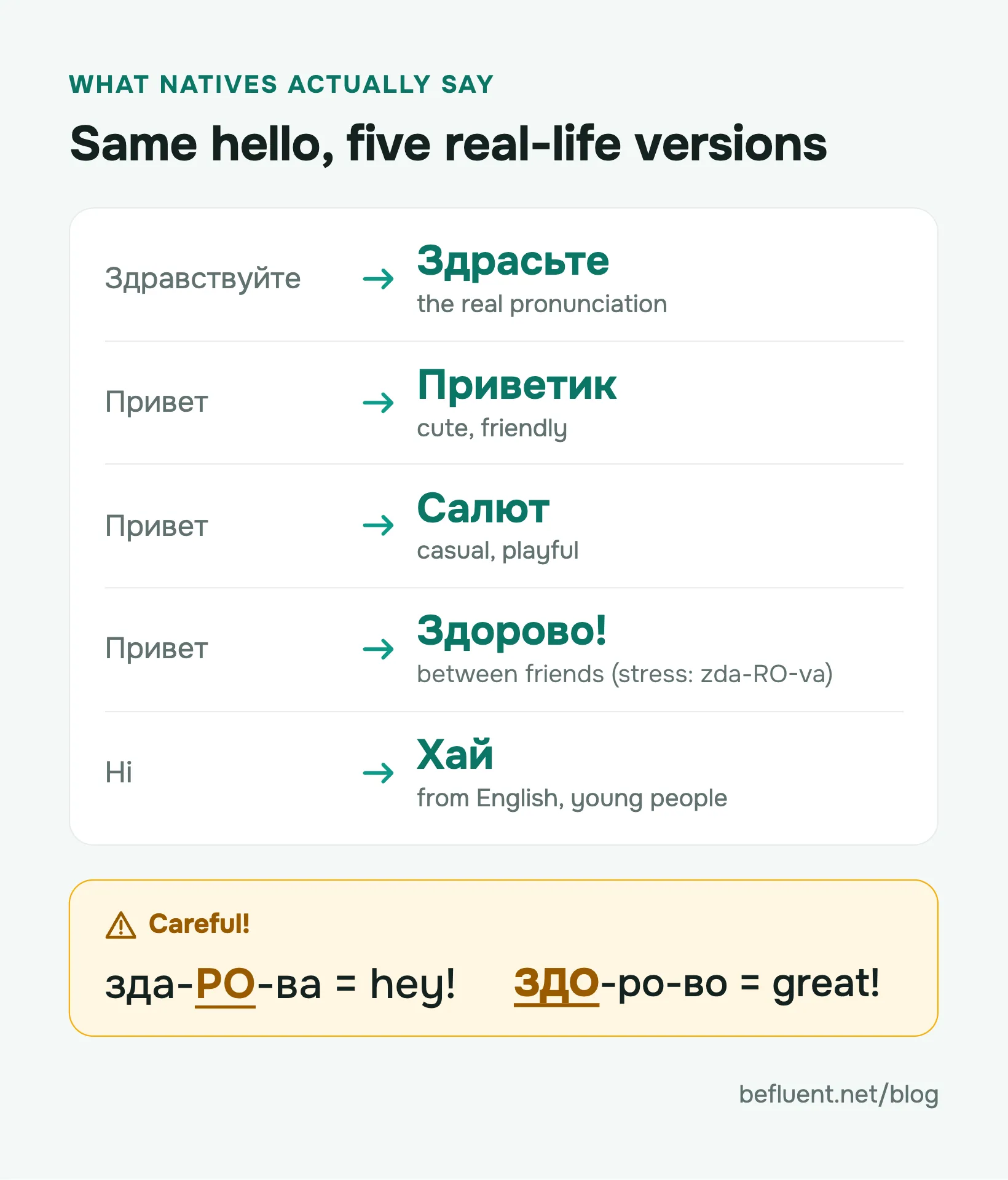
This is where textbooks stop and real life begins:
| Russian | Pronunciation | Who says it |
|---|---|---|
| Здрасьте | ZDRAS-tye | The real-life pronunciation of Здравствуйте |
| Приветик | pree-VYE-teek | A cute, friendly hi — often between women or in texts |
| Салют | sa-LYUT | Casual, a bit playful, between friends |
| Здоро́во | zda-RO-va | A hearty "hey!" between (mostly male) friends — stress on the second syllable |
| Хай | khai | Borrowed from English, young people, very casual |
Careful with the stress: здоро́во (zda-RO-va) is a greeting, but здо́рово (ZDO-ra-va) means "great!"
How to say "How are you?" in Russian
| Russian | Pronunciation | Meaning | Formality |
|---|---|---|---|
| Как дела? | kak dee-LA | How are things? | Neutral, most common |
| Как у тебя дела? / Как у вас дела? | kak oo tee-BYA / oo vas dee-LA | How are things with you? | Informal / formal |
| Как ты? / Как вы? | kak ty / kak vy | How are you? | Informal / formal, a bit more personal |
| Как жизнь? | kak ZHIZN' | How's life? | Friends |
| Что нового? | shto NO-va-va | What's new? | Friends, colleagues |
| Как сам? / Как сама? | kak SAM / sa-MA | How are you doing? (to a man / woman) | Close friends |
| Как оно? | kak a-NO | How's it going? | Very casual |
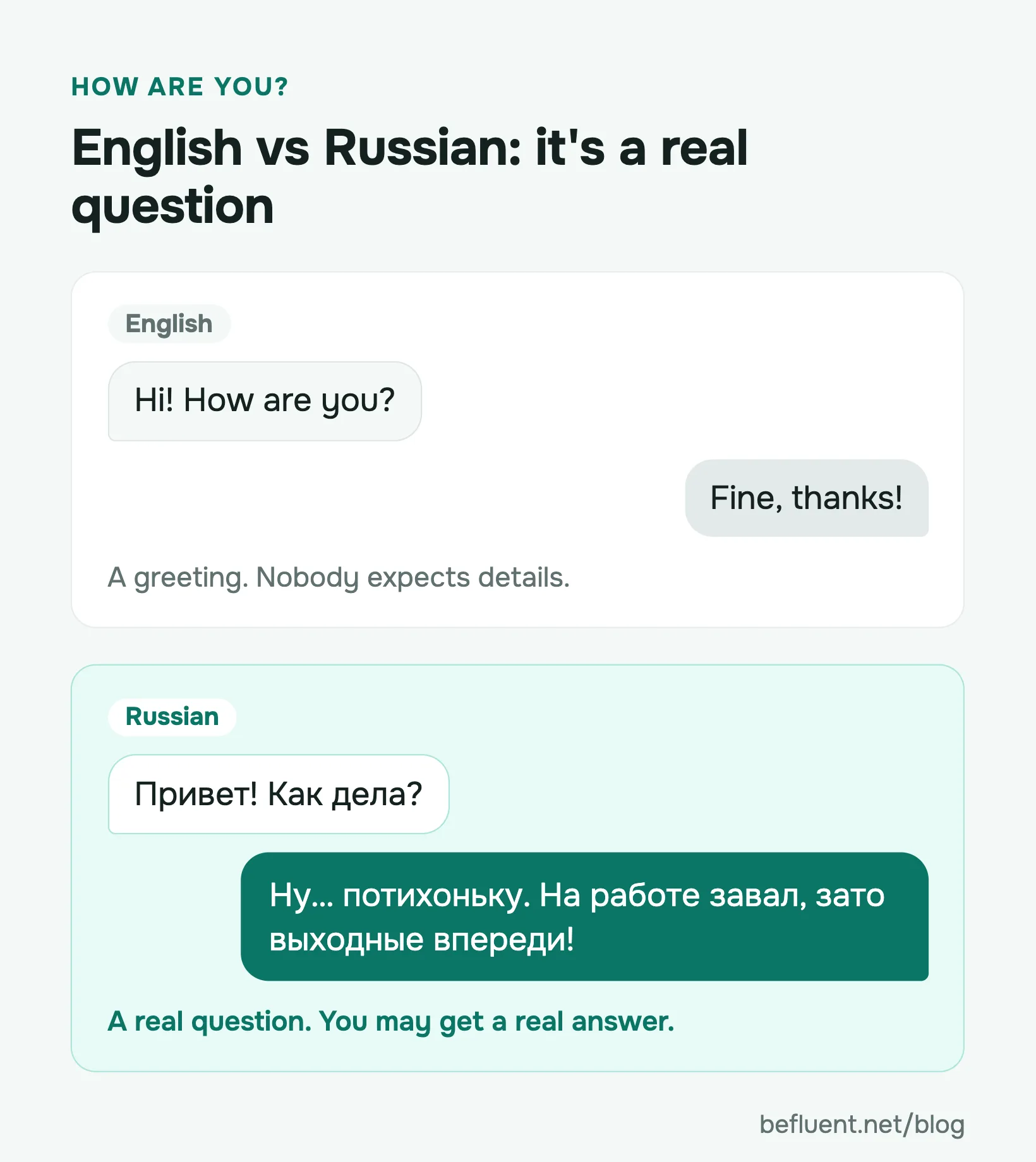
One cultural note: in English, "How are you?" is part of saying hello and nobody expects a real answer. In Russian, Как дела? is a real question. People ask it when they actually want to know — so you won't hear it from a cashier, and a friend might give you an honest, detailed answer.
How to answer «Как дела?» without sounding like a textbook
Textbooks teach you Хорошо, спасибо. А у вас? ("Good, thanks. And you?"). It's correct — and it's also how you instantly sound like you learned Russian from a book. Here's what people actually say:
| Russian | Pronunciation | Meaning | Mood |
|---|---|---|---|
| Нормально / Норм | nar-MAL-na / norm | Fine, OK | The default answer |
| Ничего | nee-chee-VO | Not bad | Neutral |
| Хорошо / Отлично | kha-ra-SHO / at-LEECH-na | Good / Great | Positive |
| Потихоньку | pa-tee-KHON'-koo | Slowly but surely / Can't complain | Calm, a bit modest |
| Как обычно | kak ab-YCH-na | Same as usual | Neutral |
| Не жалуюсь | nee ZHA-loo-yus' | Can't complain | Positive |
| Так себе | tak see-BYE | So-so | Not great |
| Лучше всех | LOOCH-she fsyekh | Better than anyone! | Playful |
Then bounce the question back with А у тебя? / А у вас? ("And you?") or simply А ты?
Why нормально is everywhere: Russians don't like to overstate. "Fine" is a perfectly happy answer. Fedor explains it in a minute:
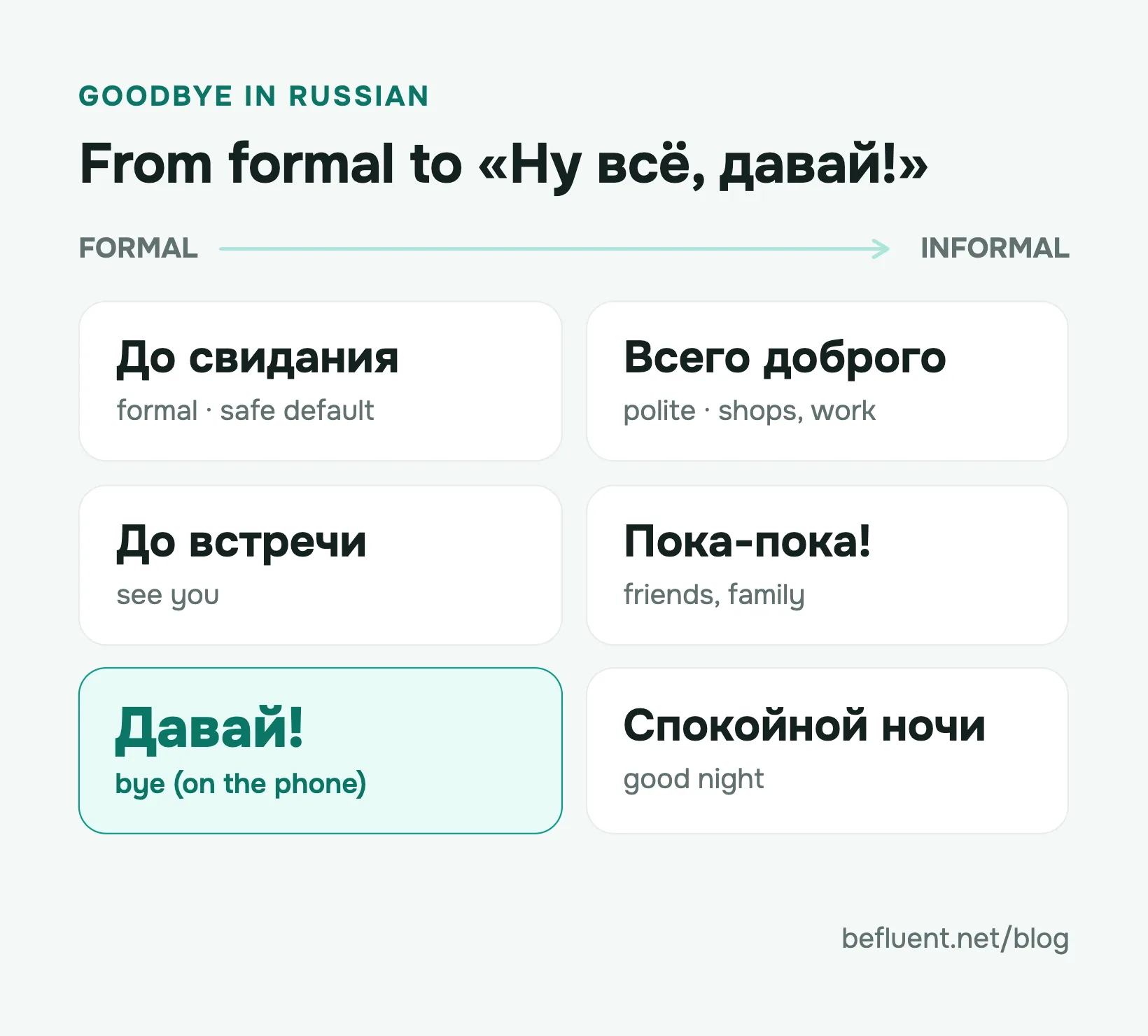
How to say goodbye in Russian
| Russian | Pronunciation | Meaning | When |
|---|---|---|---|
| До свидания | da svee-DA-nee-ya | Goodbye | Formal, the safe default |
| Пока / Пока-пока | pa-KA / pa-KA pa-KA | Bye / Bye-bye | Friends, family |
| Всего доброго / Всего хорошего | fsee-VO DOB-ra-va / kha-RO-she-va | All the best | Polite, shops, work |
| До встречи | da FSTRE-chee | See you | When you'll meet again |
| До завтра | da ZAF-tra | See you tomorrow | Colleagues, classmates |
| Увидимся | oo-VEE-deem-sya | See you | Friends |
| Счастливо | shas-LEE-va | Take care | Warm, slightly old-fashioned |
| Спокойной ночи | spa-KOY-nay NO-chee | Good night | Before bed |
And then there's Давай! — literally "come on / let's", but at the end of a phone call it simply means "bye". You'll often hear Ну всё, давай, пока! ("Right, OK, bye!"):
On the phone and in texts
- Алло (a-LO) — what Russians say when they pick up the phone. At work you may hear Слушаю (SLOO-sha-yu, "I'm listening") or just Да?
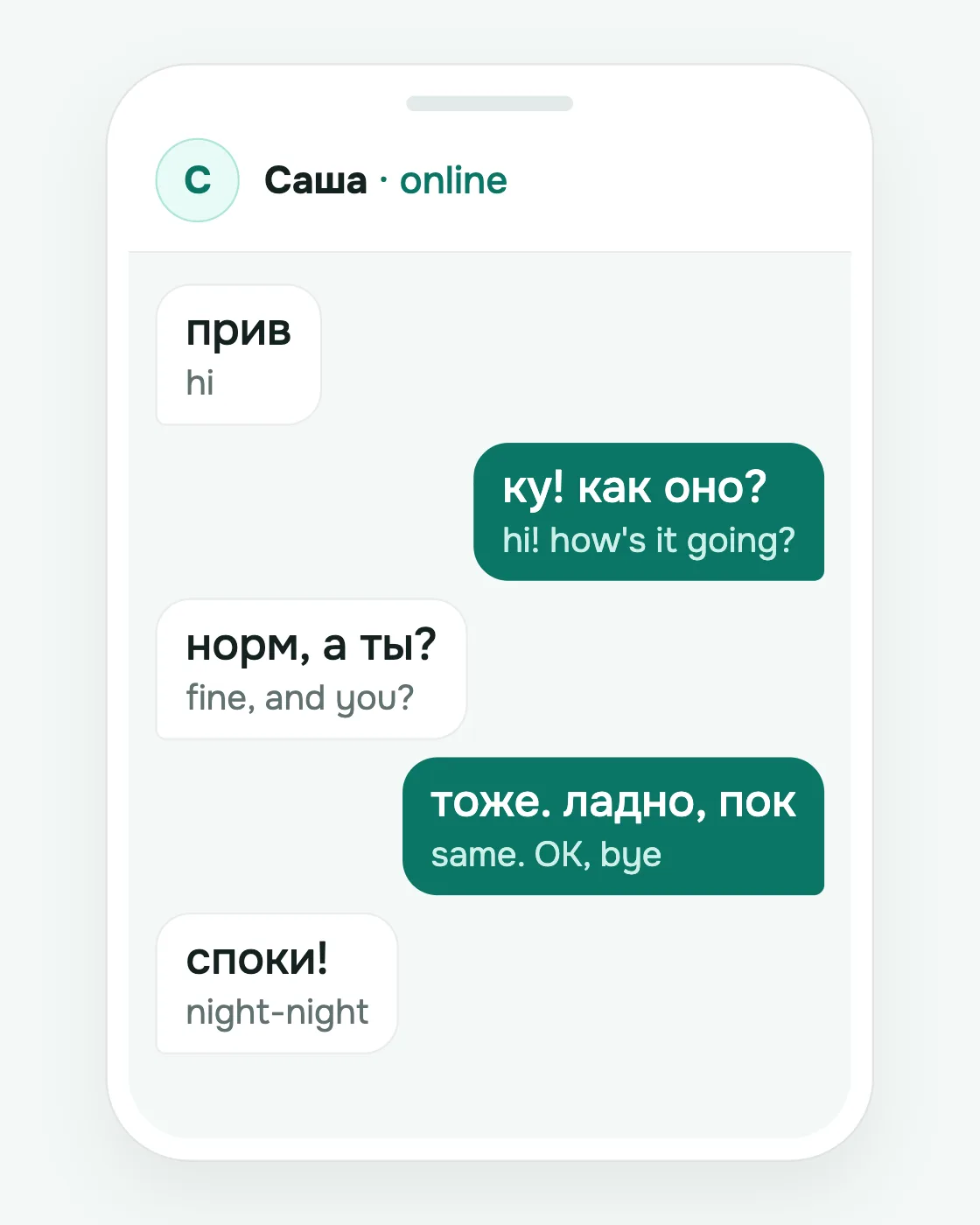
- In texts, greetings get short: прив (hi), ку (hi, from internet slang), пок (bye), споки (night-night).
5 mistakes that make you sound like a textbook
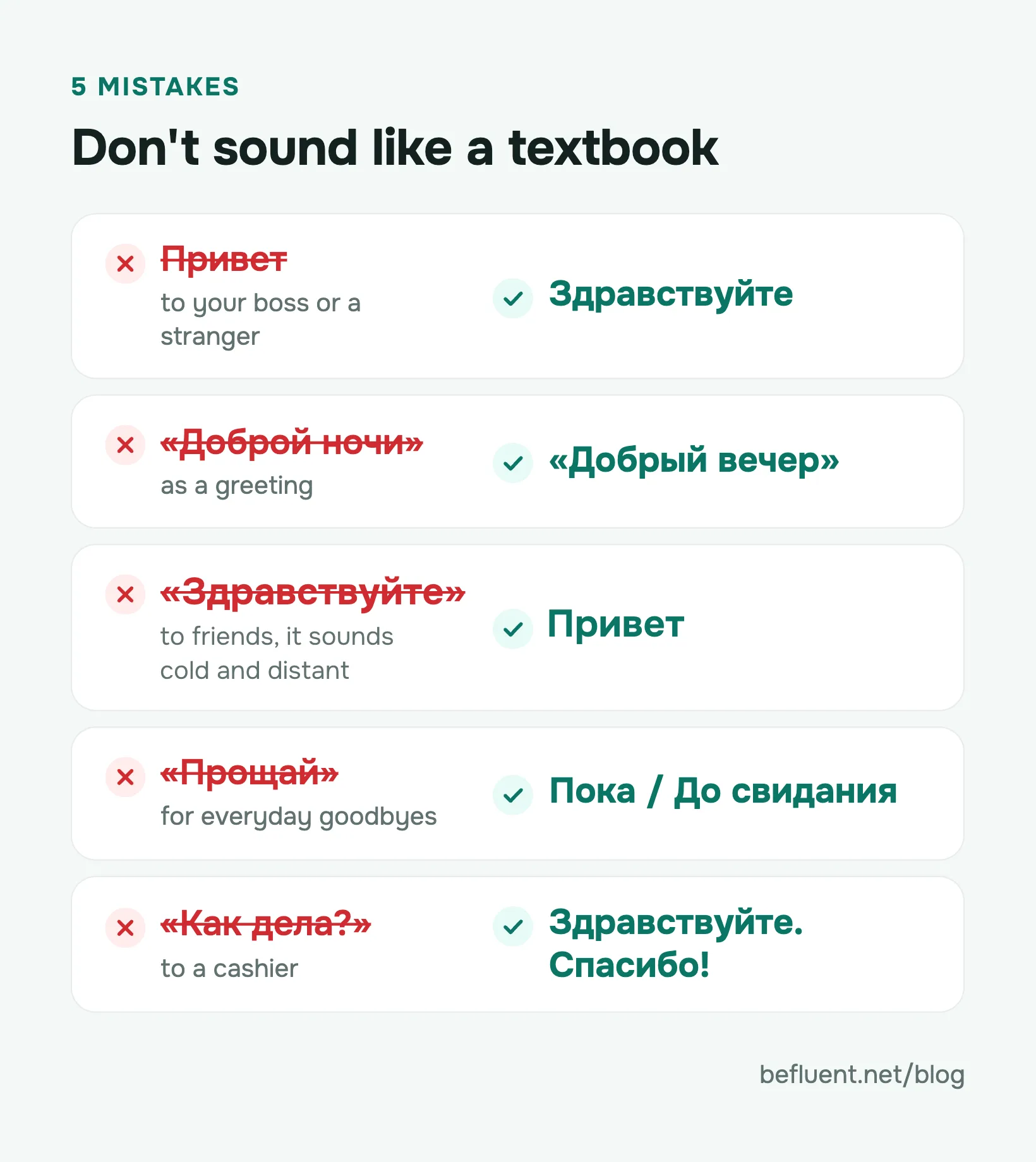
- Saying «Привет» to your boss or a stranger. It's too familiar. Use Здравствуйте or Добрый день.
- Using «Доброй ночи» as a greeting. It means "good night" — you say it when you leave.
- Saying «Здравствуйте» to friends. It sounds cold and distant, as if you've just met. With friends, it's Привет.
- Saying «Прощай» for everyday goodbyes. Прощай means "farewell forever" — it's for breakups and movie scenes. Stick to Пока or До свидания.
- Asking a cashier «Как дела?». In Russia that's a personal question. A simple Здравствуйте and Спасибо, до свидания is perfect.
Two mini-dialogues
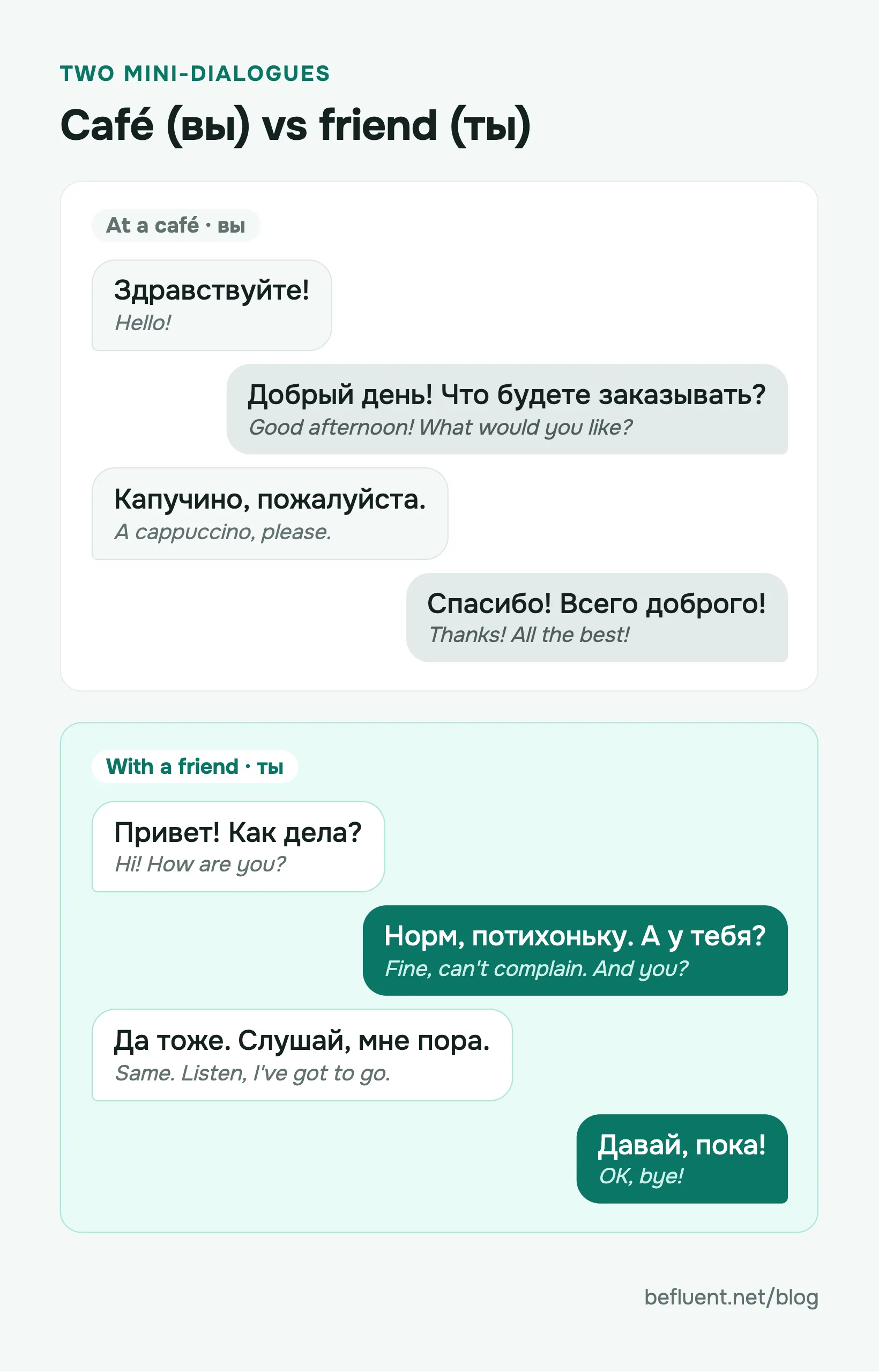
At a café (formal, вы):
— Здравствуйте! (Hello!)
— Добрый день! Что будете заказывать? (Good afternoon! What would you like?)
— Капучино, пожалуйста. (A cappuccino, please.)
— Пожалуйста, ваш кофе. (Here's your coffee.)
— Спасибо! Всего доброго! (Thanks! All the best!)
— До свидания! (Goodbye!)
Meeting a friend (informal, ты):
— Привет! Как дела? (Hi! How are you?)
— Норм, потихоньку. А у тебя? (Fine, can't complain. And you?)
— Да тоже нормально. Что нового? (Fine too. What's new?)
— Да ничего особенного. Слушай, мне пора. (Nothing special. Listen, I've got to go.)
— Давай, пока! (OK, bye!)
— Пока-пока! (Bye-bye!)
Your next step
Greetings are your first 10 seconds in Russian. What comes next — small talk, talking about yourself, keeping a conversation going — is where most learners get stuck.
- Already know these phrases? Take the free level test and get a personal learning plan.
- Want to keep going? Read 10 Russian Phrases to Avoid Awkward Silence, How to Talk About Yourself in Russian and Sorry in Russian, or start with 20 essential beginner words.
- Ready to speak from day one? Try BeFluent free for 3 days — short daily lessons that take you from your first «Привет» to real conversations.
FAQ
Structured lessons, daily practice and a built-in dictionary. Try it free for 3 days.
Start learning free


Practice this in a real conversation
Lessons turn what you just read into conversations you can actually hold. Try free for 3 days
3 days free · cancel any time