
Russian Cases Grammar: Complete Guide to All 6 Cases
Russian cases grammar (noun cases): complete guide to all 6 cases. Endings, examples & rules. Free for beginners — 12 min read.
BeFluent Team
07 Feb 2026 · ~12 min read


Cases in Russian are notorious for their complexity, but is it really that complicated? We will find out today. This complete guide will explain Russian cases in detail, covering everything case-related so that after you read this post, you will have a much better understanding of cases! Understanding cases is crucial when you learn Russian and essential for mastering Russian language learning. Once you understand cases, you'll be ready to learn how to make complex sentences using conjunctions.
Why do we need Russian Cases?
Cases in Russian serve one crucial role - they assign roles in a sentence. Cases tell us who does the action and who receives it.
In English, who is doing something and what they are doing it to is usually clear by the order of the words in the sentence. Like, "The cat catches the mouse" means the cat is the one catching, not the mouse. Flip it, and the meaning changes.
In Russian, it's a bit different. You can switch the words around more freely, like to sound fancy or to stress a point. For example:
"Иван любит Машу" is the same as "Машу любит Иван." It would still mean Ivan loves Masha. To get it right, you need to know the special "cases" in Russian grammar.
Cases tell us who did the action and who received it
In short, we have 3 roles in Russian:
- Subject - what/who's doing the action
- Direct object - what/who's receiving the action
- Indirect object - what/who's involved in the action, but doesn't receive it
Each of these roles are assigned by cases in Russian.
If you're looking to practice cases, look no further! We have got you covered! We have a number of exercises on BeFluent Class platform. Join us with the button below:

Each case breakdown
- Nominative - subject
- Genitive - indirect object, origin + quantity
- Dative - indirect object, recipient
- Accusative - direct object
- Instrumental - indirect object, after "с" + tool
- Prepositional - indirect object, after "в, на, о"
Nominative case
We use nominative case to assign a subject in a sentence. Whoever or whatever is doing the action will be in nominative case. How do you assign that case? You don't! Nominative case of a noun is the default (or dictionary) form of that noun!
Examples:
- Мама любит цветы - mom loves flowers (Мама is nominative)
- Я люблю сок - I love juice (Я is nominative)
Genitive case
This is how we form genitive case, but when do we use it?
If Nominative is pretty straight-forward, genitive case is not! It's the most complex case in Russian, because it's used in so many different scenarios. However, there's one meaning that genitive is used for most commonly - origin or possession of something. Genitive will replace the English preposition "of". And it will assign an indirect object.
A basic example:
- Телефон моего друга - a phone OF my friend
- друга here is genitive case. It went from друг to друга.
- Стакан воды - a cup OF water
- воды here is genitive case. It went from вода to воды.
There's more usages of genitive case that you can learn with this blog post.
Dative case
Dative case is used to identify the recipient of the action. The action is done TO WHOM? or TO WHAT? and that person or thing is put in dative case.
Examples:
- Я купил это маме - I bought this for mom (Маме here is dative case, because she will receive the results of me buying something.)
- Папа звонит учителю - dad calls (to) a teacher (Учителю here is dative case, because they're the recipient of the calling action.)
Dative is pretty easy to understand!
Accusative case
Accusative case assigns a direct object. To find an accusative case word all we have to do is rephrase a question like this:
- I ate an orange - what was eaten? "Orange"! "Orange" would be in accusative case
- You bought a car - what was bought? "Car"! Put "car" in accusative case
Let's see how it works:
- Я съел апельсин - I ate an orange (Апельсин here is accusative case)
- Я купил машину - I bought a car (Машину here is accusative case)
The only difficulty with Accusative case is that it has different forms for animate and inanimate objects. It's the only case that has this distinction.
Animate objects are living objects (people, professions, animals). Inanimate objects are non-living objects.
Here is the full table:
Instrumental case
Instrumental is also EXTREMELY simple. Firstly, it's easy to distinguish it from other cases by the forms of nouns. It has 2 letters for singular and 3 letters for plural! Super easy! And Instrumental case will be extremely easy in usage too:
Instrumental case is used:
- After a preposition "с" (with)
- To identify an instrument of our action (doing BY some tool)
Examples:
- Я пришёл с другом - I came with a friend (Другом is instrumental. Друг became другом. We use instrumental because другом came after "с")
- Я ем вилкой - I eat with (by) a fork (Вилкой is instrumental. Вилка became вилкой. We use instrumental because вилкой (a fork) is an instrument that we use to carry out the action at hand!)
Prepositional case
Prepositional case is the most intuitive. It's only used after prepositions! The most common ones that will demand prepositional case are:
- В - in
- На - on
- О/об - about
Examples:
- Я говорю о доме - I am talking about a house (Доме here is prepositional)
- Я стою на стуле - I am standing on a chair (Стуле here is prepositional)
- Мы в городе - we're in the city (Городе here is prepositional)
Best way to master Russian cases
Cases is a very complex topic and you shouldn't try to master it all in one day. It's best to learn cases in layers. First, you learn the basics (information above), then you drill all the endings, then you learn how cases work with prepositions, etc.
Take it slow!
And the best way to practice cases is with exercises where your knowledge is tested. We have a ton of exercises for cases on BeFluent Class. Check it out now!
Locative case
Locative case is a "secret" case in Russian that not everyone is aware of. But Locative case has simply become a variation of Prepositional case.
Only around 200 words have locative case variation - here's the list.
Think of locative as an exception to Prepositional case. A typical word would act like this:
- В комнате - in a room
- На комнате - on a room
- О комнате - about a room
Regardless of what Prepositional case preposition we throw at the word комната, it has one form for Prepositional case. It's because комната doesn't have Locative case!
But a word like снег does have locative case, and this is what it would act like:
- В снегу - in the snow
- На снегу - on the snow
- О снеге - about the snow
As you can see, the endings for В and НА are different from О. This is where locative case is hiding. It doesn't have any meaning change, it's simply a form change.
Cases and adjectives
Russian adjectives can also have cases! But, when we put an adjective into a certain case we don't worry about all the meanings of cases. We simply look at the noun that we want to describe and match the case of that noun.
Just look at the noun and copy the case for the adjective
But this is where the difficulty comes...one adjective can have a total of 28 forms! Look at this table:
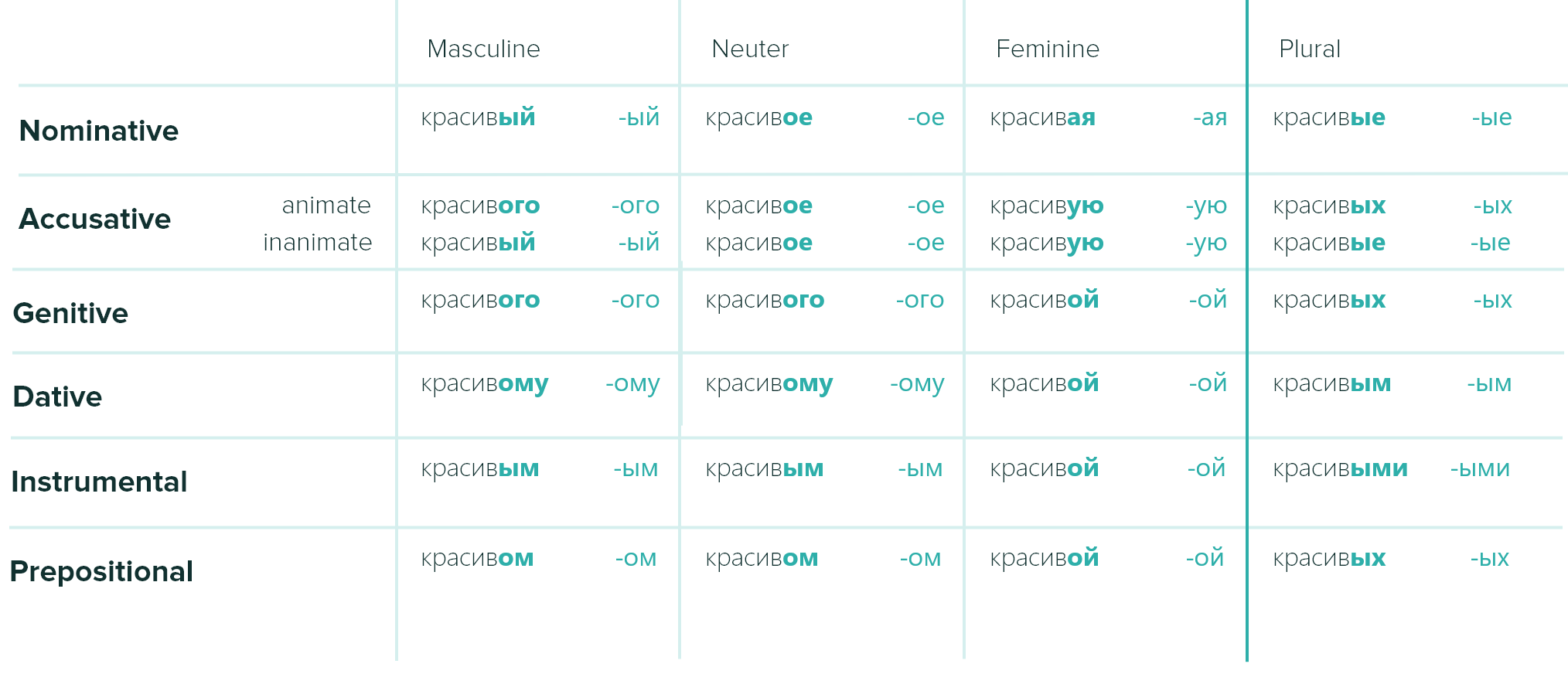
One adjective красивый (beautiful) took on so many forms! But do not worry, we can help you practice the forms above in BeFluent Class. Join us below!
Cases and prepositions
Another layer to cases is how they interact with prepositions. Cases depend on prepositions. Prepositions will demand a certain case to be used afterwards.
For example: a preposition без (without) requires us to use a genitive case noun.
- Без мамы - without mom
- Без места - without a space
Both мамы and места are genitive case, because без demands it.
And here's a full list of prepositions with cases:
If you see a preposition on the left, just put the word after it in a proper case!
Cases and "I, you, we, they"
And the last thing we must talk about is how cases work with personal pronouns in Russian. It deserves a whole section just because of how different personal pronouns look when they're declined to each case. Just take a look at this table:
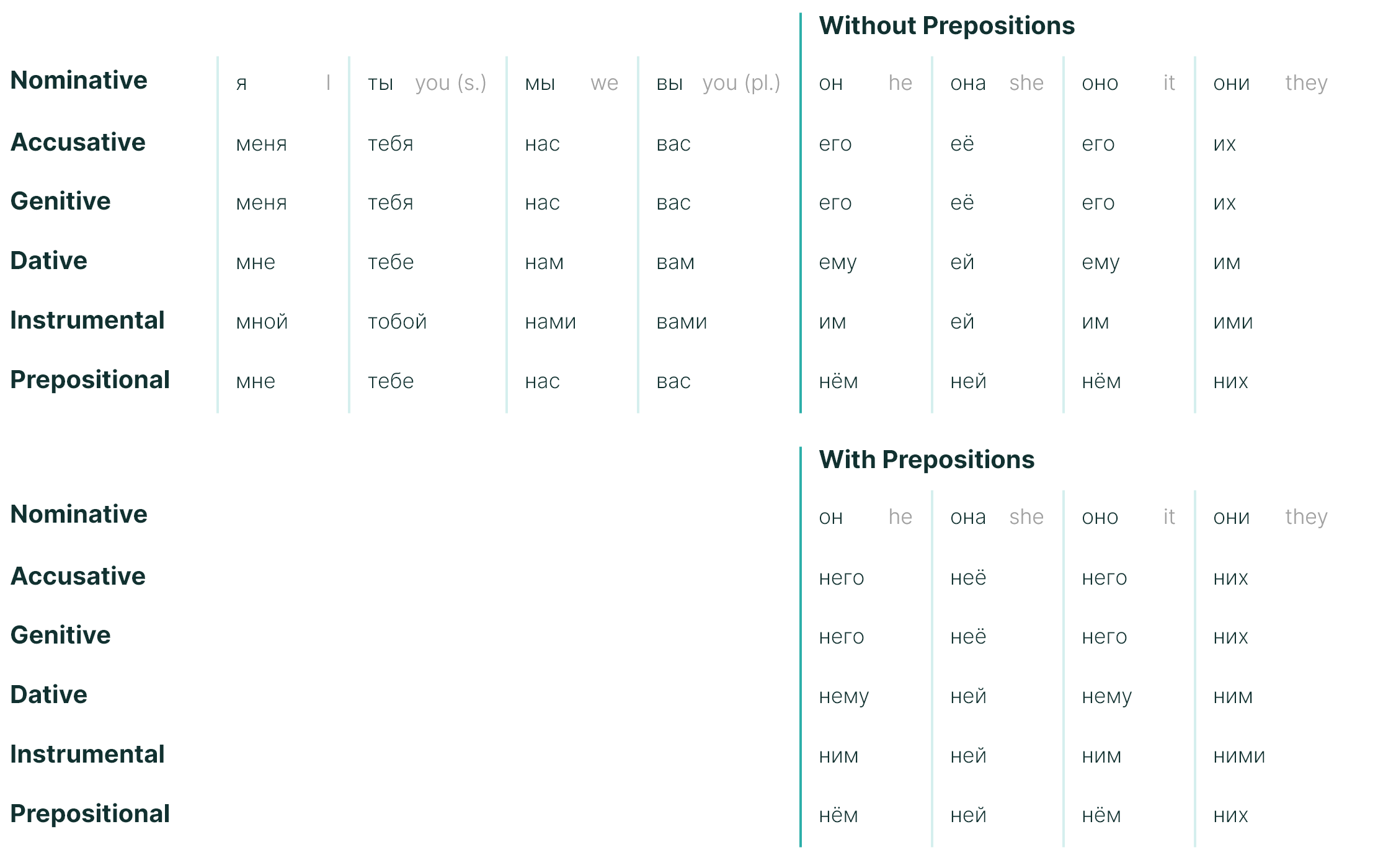
If there's a preposition before a personal pronoun, then the pronouns ОН, ОНА, ОНО, ОНИ change and they have an extra "Н" in the beginning (него, неё, них, etc.)
As you can see, personal pronouns change a lot! And we have to know how to properly use them!
And that is all about the basics of cases! Practice cases with BeFluent Class - join us here.
FAQ
Structured lessons, daily practice and a built-in dictionary. Try it free for 3 days.
Start learning free


Practice this in a real conversation
Lessons turn what you just read into conversations you can actually hold. Try free for 3 days
3 days free · cancel any time